Wednesday, July 29, 2009

One Nice Home In A Great Area = Only 2 exist on this beach


One of only two beachfront homes in this vibrant beach town on the Marin Coast, just over an hour from SF! Renovated, turn-of-the-century estate with gated parking, patios, private gardens, hot tub, sauna, surfer/dog's shower, sun decks, gourmet kitchen, utility/laundry/exercise rm, 2 master suites, Jack & Jill bedroom w/ bath, guest bedroom suite, living room + den both w/ Mariposa slate fireplaces, covered porch, loft, office, ample storage. ..


Monday, July 27, 2009

The Golden State


More Californians were delinquent on their mortgages in the second quarter this year than the same period a year ago, but fewer lost their homes from April through June than in the second quarter the previous year, a real estate research firm reported today.
Lenders sent out a total of 124,562 default notices during the second quarter – these notices are the first stage in the foreclosure process and are sent when a borrower misses numerous payments. That was down 8% from the previous quarter’s record 135,431 default notices, and up 2.4% from 121,673 in the second quarter 2008, DataQuick reported.
Trustees Deeds recorded, or the actual loss of a home to foreclosure, totaled 45,667 during the second quarter. That’s up 5 % from 43,620 for the previous quarter, and down 28% percent from 63,316 for second-quarter 2008. They reached a record 79,511 during last year’s third quarter before dropping following a state law that slowed the foreclosure process and voluntary moratoriums by lenders.
DataQuick President John Walsh said the bogged-down pace of foreclosures may be ending. "There is a perception that the housing market is dragging along bottom, that it probably won’t get much worse, and that the lenders need to get serious about processing the backlog of delinquencies, either with work-outs or foreclosure. We’re hearing that some lenders and servicers are doing just that, hiring more people to do the necessary paperwork. That means the foreclosure numbers will probably shoot back up during the third quarter," Walsh said


Foreclosures that are getting sold right now are mostly 2/28 subprime loans that stopped in 2006 and were fixed for 2 years before adjusting upwards. It takes about 11 months on average to foreclose and sell a property so the stuff that's selling now was 2/28 paper originated in mid 2006. The next wave will be from 5/1 mortgages, also stopped in 2006. These were loans made to people with great credit, but stated income. They will start adjusting in 2011 and unless values return AND lenders begin doing stated income mortgages again, there is no way that these borrowers can avoid foreclosure. With the 11 month foreclosure cycle, we are looking at a dearth of REO in 2012. Hate to be bearish, but reality is what it is.

Friday, July 24, 2009

Fannie Mae Housing


The former CEO of Fannie Mae Daniel Mudd took a lot of flack last year for chilling in his luxurious Washington, DC, home while the rest of the country reeled in mortgage turmoil. Now, as the NY Post's Gimme Shelter reports it's Mudd's turn to test the market. Mudd is selling his Washington D.C. home and looking to buy or rent in Greenwich, Connecticut or nearby because he starts his new job at New York's Fortress Investment Group on Aug. 11. Mudd's home which earned the nickname Mudd Manor last year is a Georgian-style estate built in 1927. It sits on an acre of land that includes a pool, gated drive and carriage house with a three-car garage. The home has a luxurious master suite, sunroom, brick fireplaces, French doors and original wood details including bookshelves and wainscoting.There is also a home theater, wine cellar and servant's quarters. It is listed at $9.5 million.

Wednesday, July 8, 2009

Beazer settles $50M mortgage fraud case


Beazer Homes USA Inc. agreed to pay $5 million to the U.S. government and up to $48 million to private homeowners to settle allegations that it was involved in fraudulent mortgage activities, the Justice Department said Wednesday.
The settlement resolved allegations that Beazer and its mortgage unit, Beazer Mortgage Corp. in making Federal Housing Administration insured loans were involved in fraudulent mortgage origination activities, the department said.
The Justice Department, which has focused on pursuing mortgage fraud cases during the economic downturn, said as a result of Beazer's alleged activities unqualified home buyers were "induced" to enter into FHA insured mortgages and interest rates for the loans were "improperly inflated."
The U.S. government agreed not to prosecute the company in connection with the case if the firm satisfies its obligations under the deferred prosecution agreement over the next 60 months.
In Atlanta, the company said in a statement that it has fully cooperated with the investigations by various government authorities and that it had reached a settlement.
"We deeply regret these matters and have used what we have learned to strengthen our control and compliance culture and reinforce our absolute commitment to act according to the highest standards of ethical conduct," said Ian McCarthy, president and chief executive officer.
Separately, the U.S. Securities and Exchange Commission Wednesday accused Michael Rand, a former chief accounting officer at Beazer, of running a fraudulent scheme to manipulate the builder's results.

Tuesday, June 30, 2009

King Of Pop Was Also The King OF High Rents


This is the Kent mansion into which Michael Jackson was due to move this weekend.
The property’s owner, businessman Osman Ertosun, and his wife and two children moved out of aprox. 31 Million Dollar manor in Chislehurst, Kent, more than a week ago and were preparing to stay elsewhere for a year.
The Grade II-listed mansion is among the largest private properties in Greater London. Jackson paid about 2 million to rent it until next February. His concert venue, the O2 Arena, is just ten miles away.
The star had personally selected the house after visiting it secretly around the time of his Press conference in London in March.


Here is the rental where he died. His rent was $100,000 per month. Then of course you need grounds keepers, maids, utility bills, etc. May his soul rest in peace.


Bel Air is an affluent residential area located in the Westside hills in Los Angeles, California. Home to the stars, Bel Air forms the famous Platinum Triangle of Los Angeles, together with Beverly Hills and Holmby Hills.
The whole area is divided into two sectors. The lower portion is strictly residential, and houses the older estates north of the Sunset Boulevard. It boasts of vast expanses of flat and lush scenery, and is the spot to look into for those who plan on leasing a mansion. The upper portion weaves through the foothills of the Santa Monica Mountains. The area consists of the more quaint homes from post-World War II, and a couple of commercial districts along Mulholland Drive.
Many celebrities have made their homes within the gates of Bel Air. In fact, some of the more recent celebrity purchases include singer Avril Lavigne, who with her husband recently settled in a 12,000-square-foot mansion that cost them $9.5 million, and controversial singer Rihanna, who had to shell out $12 million for a Bel Air mansion. Of course, stars like Paris Hilton, Meg Ryan and Jennifer Lopez are also neighbors in the plush neighborhood.
The attraction of this neighborhood as a celebrity community is such that many find ways to stay in it despite financial troubles. Embattled pop singer Michael Jackson, for one, has taken the option of leasing a mansion in Bel-Air. In the midst of news about his financial woes, the singer recently signed a one-year lease contract for $100,000 per month over a mansion with seven bedrooms, 13 bathrooms and 12 fireplaces.
And who wouldn't fall for the grand Bel Air charm and not consider leasing a mansion in Bel Air? Imagine the typical image of a Bel Air home: a house as big as a palace fit for a royal family, nestled on a vast expanse of manicured lawn, a lush garden of greens, a driveway and a big garage for your Mercedes and Porsches, a swimming pool and a tennis court, and a man in a tuxedo standing by to open the door for you.
Indeed, many affluent families who are looking for a taste of the celebrity life have considered leasing a mansion in this area as the next best thing to buying real property there. For anywhere between $20,000 to a whopping $100,000 a month, you can live the high life in this area and enjoy its star-studded attractions such as the Bel Air Country Club and the Hotel.


Wednesday, June 24, 2009

A nice piece of good news.....


********************************************************************************

I was at the state captial today and read a very positive real etsate piece in a paper called the SAC BEE and wanted to share it with you.

***********************************************************************************


Home sales, median prices rise in May
ShareThis
By Jim Wasserman


Sacramento-area home buyers closed escrow on 3,420 new and existing houses in May, a 14th straight month of sales climbing higher than the same month a year earlier.
May,which typically kicks off the summer buying season, also saw median sales prices rise again in five area counties, according to statistics released today La Jolla property researcher MDA DataQuick.
But it may be early to celebrate such tentative signals of improvement, as thousands of Sacramento-area borrowers still struggle with home loans. New notices of defaults across the region reached 3,633 in May and outnumbered home sales in Amador, El Dorado, Nevada, Placer, Sacramento, Sutter, Yolo and Yuba counties, according to Bay Area-based tracker ForeclosureRadar. Not all, however, are expected to become foreclosures.
Sacramento County showed one of the biggest improvements regionally, with prices for existing homes alone climbing a dramatically higher 9.4 percent - from $160,000 in March and April to $175,000 in May.
But that was still 22 percent below the May 2008 median of $225,000.
DataQuick analyst Andrew LePage attributed the abrupt May rise to a sales mix reflecting fewer hugely discounted bank repos and more higher-priced homes.
"It's not home appreciation," he said. "It's just getting back to a more normal distribution of sales across the home price spectrum."
Still, he said, "It could be that we've seen the lowest median in Sacramento County."
Here's why:
Overall, the market share of bank repos fell to 59 percent in May in Sacramento County. That's down from a high of 71 percent in January and follows several rounds of foreclosure moratoriums.
• Homes priced below $100,000 in Sacramento County fell to their lowest level since Nov. 2008.
• Sales priced between $200,000 and $500,000 rose 13 percent from April to May in the capital county.
Prices for new and existing homes combined also rose from April to May in Amador, El Dorado, Nevada and Yolo counties. Prices were unchanged in Placer County and fell slightly in Sutter and Yuba counties, DataQuick reported.
These generally rising median sales prices - where half cost more and half less - reflected an upward statewide trend in May. DataQuick statistics showed a 12.3 percent rise from April in the nine-county Bay Area. The six-county Los Angeles region, including San Diego, saw the regional median rise slightly for the first time since July 2007.
DataQuick May sales highlights for new and existing homes combined in the region:
• Amador County reported a $209,500 median in May, price, up from $180,000 in April and down 29.5 percent from May 2008
• (El Dorado Countys median was $325,000, up from $313,000 in April and down 15.4 percent from the same time last year.
• Nevada County's median reached $352,000, up from $322,500 in April. The May median was just 0.6 percent lower than the same month last year.
• Placer County reported a $295,000 median price, unchanged from April, and 13 percent below the same time last year.
• Sutter County's $165,000 median was down from $170,000 in April and 15.4 percent below the same time last year.
• The Yolo County median of $276,000 climbed from $242,000 in April. It was down 12 percent from May 2008.
• Yuba County's $152,000 median was down slightly from $156,500 in April and is still down 26.4 percent from the same month in 2008.

Wednesday, June 17, 2009

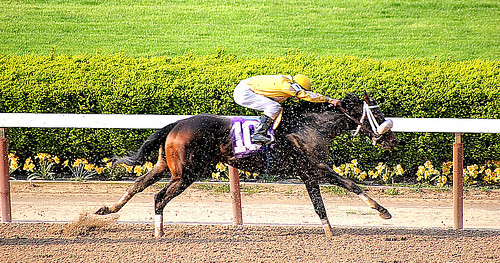
The Horses Are On The Track


---Southern California home sales rose for the 11th consecutive month in May as sales of $500,000-plus homes started to come back. The median price paid increased slightly from the prior month for the first time since July 2007, the result of a shift in market activity where sales of deeply discounted foreclosures waned and mid- to high-end purchases rose, a real estate information service reported.
A total of 20,775 new and resale houses and condos closed escrow in San Diego, Orange, Los Angeles, Ventura, Riverside and San Bernardino counties last month. That was up 1.3 percent from 20,514 in April and up 22.8 percent from 16,917 a year ago, according to San Diego-based MDA DataQuick.
Sales have increased year-over-year for 11 consecutive months.
May’s sales were the highest for that month since May 2006, when 30,303 homes sold, but were 21.2 percent below the average May sales total since 1988, when DataQuick’s statistics begin.
Foreclosure resales – homes sold in May that had been foreclosed on in the prior 12 months – accounted for 50.2 percent of all Southland resales. That was down from 53.5 percent in April and from a peak of 56.7 percent in February. May’s figure was the lowest since foreclosure resales were 50.9 percent of all resales last October.
The remarkably sharp declines in the Southland’s median sale price over the past year have been exacerbated by a shift toward an above-average number of sales occurring in lower-cost inland markets rife with discounted foreclosures. However, the number of homes lost to foreclosure declined over the winter, leaving fewer for bargain hunters to scoop up this spring. Meantime, sales have begun to rise a bit in many mid- to high-end markets, which could be due at least in part to sellers dropping their asking prices.
Last month 83 percent of the existing Southland houses sold were purchased for less than $500,000, compared with 84.8 percent in April. Conversely, sales $500,000 and above rose from 15.2 percent of sales in April to 17 percent in May. The last time the $500,000-plus market made up more than 17 percent of all sales was last October, when they were 19.9 percent of sales.
The median price paid for all new and resale houses and condos sold in the six-county Southland last month was $249,000, up 0.8 percent from $247,000 in April but down 32.7 percent from $370,000 a year ago.
The median price hadn’t risen from one month to the next since July 2007, when it increased 0.6 percent from $502,000 to $505,000.
Last month’s median was the second-lowest for any month since it was $242,000 in February 2002, and it stood 50.7 percent below the peak $505,000 median reached in spring and summer of 2007.
“We appear to be in the early stages of the market gradually tilting back toward a more normal balance of sales across the home price spectrum. As more sellers get realistic, more buyers get off the fence and more lenders offer reasonable terms for high-end purchase financing, we’ll see a more normal share of sales in the more established, higher-cost areas that have been nearly comatose,” said John Walsh, MDA DataQuick president.
“Let’s not forget we’re into the traditional home buying season right now,” he continued, “meaning more people are purchasing for all of the normal reasons, such as a new job or to get settled before school starts. Many are concerned with finding the right home in the right area, not just the most deeply discounted home.”
Among the reasons high-end sales have been nearly frozen the past year: The “jumbo” mortgages needed to buy such homes have been more expensive and much harder to obtain since August 2007, when the credit crunch hit. Before then, nearly 40 percent of Southland sales were financed with jumbo loans, then defined as over $417,000. Last month it was only 12.0 percent, though that was up from 10.6 in April and the highest since last November, when $417,000-plus loans were used for 12.2 percent of home purchases.
At the lower end of the price spectrum, first-time buyers continue to rely heavily on government-insured FHA financing. Such loans were used to finance 38.4 percent of all Southland home purchases last month, down slightly from 38.9 percent in April but up from 19.7 percent a year ago. In the Inland Empire, more than half of all May home purchases were financed with FHA loans.
Absentee buyers, including investors who will have their property tax bills sent to a different address, bought 19.4 percent of the Southland homes sold last month. That’s up from 16.9 percent a year ago and 18.6 percent in April. The monthly average since 2000: 15 percent.
MDA DataQuick is a division of MDA Lending Solutions, a subsidiary of Vancouver-based MacDonald Dettwiler and Associates. MDA DataQuick monitors real estate activity nationwide and provides information to consumers, educational institutions, public agencies, lending institutions, title companies and industry analysts.
The typical monthly mortgage payment that Southern California buyers committed themselves to paying was $1,052 last month, up from $1,038 the previous month, and down from $1,782 a year ago. Adjusted for inflation, current payments are 52.1 percent below typical payments in the spring of 1989, the peak of the prior real estate cycle. They are 60.7 percent below the current cycle's peak in July 2007.
Indicators of market distress continue to move in different directions. Foreclosure activity remains near record levels, while financing with adjustable-rate mortgages is near the all-time low, as is financing with multiple mortgages. Down payment sizes and flipping rates are stable. Non-owner occupied buying has risen and is above-average in some markets, MDA DataQuick reported.

Thursday, June 4, 2009

3 Months In A Row.........


Pending Home Sales Rise 6.7% / Third Straight Month of increase The Pending Home Sales Index, a forward-looking indicator based on contracts signed in April, rose 6.7%, to 90.3 from a reading of 84.6 in March, and is 3.2% above April 2008, when it was 87.5, the group said. Economists surveyed by Thomson Reuters (TRI) had expected the index would edge up to 85 from a reading of 84.6 in March. It was the biggest monthly jump since October 2001.
Pending home sales activity was greatest in the Northeast, where the index increased 32.6%, to 78.9, in April, 0.8% above a year ago. The only region that showed a decrease was the South, where the index declined 0.2%, to 93.0, 3.5% higher than a year ago. In the Midwest the index rose 9.8%, to 90.4, and is 11.1% above April 2008. In the West the index rose 1.8%, to 94.8, but is 2.9% below a year ago.
NAR’s Lawrence Yun, the group’s chief economist, said buyers are responding to very favorable market conditions, and while the total number of existing-home sales is expected to improve, there will be sharp local variations. “The market has already bottomed in some areas, but this is an unusual housing cycle with some areas improving rapidly while others languish or decline,” Yun said in a news release.
Typically there is a one- to two-month lag between a contract and a done deal, so the index is a barometer for future existing-home sales.
Paul Dales, U.S. economist for Capital Economics in Toronto, said
“The pending home sales index has now improved for three months in a row, adding to the evidence that housing activity is finding a floor,” Dales wrote. Nevertheless, even if existing-home sales were to rise to 5.1 million, they would still be 30% below their peak. Accordingly, even if activity is finding a floor, it is at staggeringly low levels.”

Saturday, May 30, 2009

Say It's So ......


Housing Prices Pick Up in California As the biggest residential property market in the United States, California often serves as a bellwether for the nation's economic health. And new research from that state suggests that housing prices nationally could start to rebound relatively soon.The latest data, including two consecutive monthly gains in the median price of existing homes, has some industry officials hopeful that the state housing market has finally reached a bottom and is poised to recover from a prolonged period of declining residential values. In April, California's single-family median home price rose 1.4 percent to $256,700. While that is still off by more than 36 percent from April 2008, the 540,360 homes sales on a seasonally adjusted annual basis reflect an increase of almost 50 percent over the same period, according to the state’s REALTORS® group.

Thursday, May 28, 2009

1972


Foreclosure actions were initiated on 1.37 percent of first mortgages during the first quarter of 2009, according to the Mortgage Bankers Association. This was a 29 basis point increase over the fourth quarter of 2008 and a 36 basis point increase from one year ago. Both the level of foreclosures started and the size of the quarter over quarter increase are record highs.
According the MBA’s National Delinquency Survey, the delinquency rate for mortgage loans on one-to-four-unit residential properties was 8.22 percent on a non-seasonally adjusted basis, down 41 basis points from 8.63 percent in the fourth quarter of 2008. Delinquency rates always decline in the first quarter of the year due to a variety of seasonal factors. After accounting for these factors, the seasonally adjusted delinquency rate was 9.12 percent of all loans outstanding as of the end of the first quarter of 2009, up 124 basis points from the fourth quarter of 2008, and up 277 basis points from one year ago. The seasonally adjusted rate is the highest in the MBA’s records going back to 1972 and the unadjusted rate is the highest recorded in the first quarter of any year back to 1972. The delinquency rate includes loans that are at least one payment past due but does not include loans in the process of foreclosure. The percentage of loans in the foreclosure process at the end of the first quarter was 3.85 percent, an increase of 55 basis points from the fourth quarter of 2008 and up 138 basis points from one year ago. Both the foreclosure inventory percentage and the quarter to quarter increase are record highs.
The combined percentage of loans in foreclosure and at least one payment past due, meaning the percentage of mortgage holders not current on their mortgages, was 12.07 percent on a non-seasonally adjusted basis, the highest ever recorded in the MBA delinquency survey.
“The increase in the foreclosure number is sobering but not unexpected. The rate of foreclosure starts remained essentially flat for the last three quarters of 2008 and we suspected that the numbers were artificially low due to various state and local moratoria, the Fannie Mae and Freddie Mac halt on foreclosures, and various company-level moratoria,” said Jay Brinkmann, MBA’s chief economist. “Now that the guidelines of the administration’s loan modification programs are known, combined with the large number of vacant homes with past due mortgages, the pace of foreclosures has stepped up considerably.”
“In looking at these numbers, it is important to focus on what has changed as well what continue to be the key drivers of foreclosures. What has changed is the shifting of the problem somewhat away from the subprime and option ARM/Alt-A loans to the prime fixed-rate loans. The foreclosure rate on prime fixed-rate loans has doubled in the last year, and, for the first time since the rapid growth of subprime lending, prime fixed-rate loans now represent the largest share of new foreclosures. In addition, almost half of the overall increase in foreclosure starts we saw in the first quarter was due to the increase in prime fixed-rate loans. More than anything else, this points to the impact of the recession and drops in employment on mortgage defaults.
“What has not changed, however, is the oversized impact of California, Florida, Arizona and Nevada in driving up the national numbers. Those states continue to account for about 46 percent of the foreclosure starts in the country, and represented 56 percent of the increase in foreclosure starts, including half of the increase in prime fixed-rate foreclosure starts.
“It is difficult to overstate the severe impact home price declines have had on mortgage performance in those four states. 10.6 percent of the mortgages in Florida are now somewhere in the process of foreclosure. In Nevada it is 7.8 percent, Arizona 5.6 percent and California 5.2 percent.
“In the first three months of this year, foreclosure actions were started on 3.4 percent of the mortgages in Nevada, 2.8 percent of the mortgages in Florida, 2.5 percent of the mortgages in Arizona and 2.2 percent of the loans in California. In comparison, the states with the highest foreclosure rates in the hard hit Midwest were Michigan and Illinois at 1.5 percent and Indiana and Ohio at 1.3 percent.
“While the national foreclosure start rate was 1.37 percent in the first quarter, in California, Florida, Nevada and Arizona it was 2.45 percent. Absent those four states, the national rate would have been 1.01 percent.
“Looking forward, it does not appear the level of mortgage defaults will begin to fall until after the employment situation begins to improve. MBA’s forecast, a view now shared by the Federal Reserve and others, is that the unemployment rate will not hit its peak until mid-2010. Since changes in mortgage performance lag changes in the level of employment, it is unlikely we will see much of an improvement until after that,” said Brinkmann.
Change from last quarter (fourth quarter of 2008)
The seasonally adjusted delinquency rate increased 100 basis points to 6.06 percent for prime loans, increased 307 basis points to 24.95 percent for subprime loans, increased 11 basis points to 13.84 percent for FHA loans, and increased 69 basis points to 8.21 percent for VA loans. Seasonally adjusted rates should be viewed with a degree of caution because the statistical models behind the adjustments were estimated based on a much more benign environment. Since the current levels of delinquencies are far outside the range of most of the values used to build the models, the seasonally adjusted numbers may considerably overestimate or even underestimate the true long-term trends.
The percentage of loans in the foreclosure process increased 61 basis points to 2.49 percent for prime loans, and increased 63 basis points for subprime loans to 14.34 percent. FHA loans saw a 33 basis point increase in the foreclosure inventory rate to 2.76 percent, while the foreclosure inventory rate for VA loans increased 27 basis points to 1.93 percent.
The non-seasonally adjusted foreclosure starts rate increased 26 basis points to 0.94 percent for prime loans and increased 69 basis points for subprime loans to 4.65 percent. The rate increased 15 basis points for FHA loans to 1.10 percent and increased seven basis points for VA loans to 0.72 percent.
The seriously delinquent rate, the non-seasonally adjusted percentage of loans that are 90 days or more delinquent, or in the process of foreclosure, was up from both last quarter and from last year. This measure is designed to account for inter-company differences on when a loan enters the foreclosure process.
Compared with last quarter, the seriously delinquent rate increased for all loan types. The rate increased 96 basis points for prime loans to 4.70 percent, increased 177 basis points for subprime loans to 24.88 percent, increased 39 basis points for FHA loans to 7.37 percent, and increased 30 basis points for VA loans percent to 4.42 percent.
Change from last year (first quarter of 2008)
On a year-over-year basis, the seasonally adjusted delinquency rate increased for all loan types. The delinquency rate increased 235 basis points for prime loans, increased 616 basis points for subprime loans, increased 112 basis points for FHA loans, and increased 99 basis points for VA loans.
The percentage of loans in the foreclosure process increased 127 basis points for prime loans and 360 basis points for subprime loans. The rate increased 36 basis points for FHA loans and 69 basis points for VA loans.
The non-seasonally adjusted foreclosure starts rate increased 39 basis points for prime loans, 57 basis points for subprime loans, 14 basis points for FHA loans, and 21 basis points for VA loans.
The seriously delinquent rate was 271 basis points higher for prime loans and 846 basis points higher for subprime loans. The rate also increased 178 basis points for FHA loans and 154 basis points for VA loans.

Saturday, May 23, 2009

Have A Great Memorial Day


Born down in a dead mans town

The first kick I took was when I hit the ground

You end up like a dog thats been beat too much

Till you spend half your life just covering up

Born in the u.s.a.,

[I] was born in the u.s.a.

[I] was born in the u.s.a., born in the u.s.a.

Got in a little hometown jam

So they put a rifle in my handSent me off to a foreign land

To go and kill the yellow man

Born in the u.s..a....

Come back home to the refineryHiring man

said son if it was up to me

Went down to see my v.a. man

He said son, dont you understand

I had a brother at khe sahn

Fighting off the viet cong

Theyre still there, hes all gone

He had a woman he loved in saigon

I got a picture of him in her arms

nowDown in the shadow of the penitentiary

Out by the gas fires of the refineryIm ten years burning down the road

Nowhere to run aint got nowhere to go

Born in the u.s.a.,

[ I ]was born in the u.s.a.Born in the u.s.a.,

Im a long gone daddy in the u.s.a.B

orn in the u.s.a., born in the u.s.a.Born in the u.s.a.,

Im a cool rocking daddy in the u.s.a.


"Born in the U.S.A." is a 1984 song written and performed by Bruce Springsteen. Taken from the album of the same name, it is one of his best-known singles. Rolling Stone ranked the song 275th on their list of the 500 Greatest Songs of All Time. In 2001, the RIAA's Songs of the Century placed the song 59th (out of 365). Lyrically, the song deals with the effects of the Vietnam War on Americans although it is widely misinterpreted as a patriotic anthem.